Showing posts with label video surveillance. Show all posts

China Enacting a High-Tech Plan to Track People

0 comments

Today's New York Times has an interesting article on new surveillance technologies being built by American companies for use in China:

China Enacting a High-Tech Plan to Track People - New York Times

... Starting this month in a port neighborhood and then spreading across Shenzhen, a city of 12.4 million people, residency cards fitted with powerful computer chips programmed by the same company will be issued to most citizens.

Data on the chip will include not just the citizen’s name and address but also work history, educational background, religion, ethnicity, police record, medical insurance status and landlord’s phone number. Even personal reproductive history will be included, for enforcement of China’s controversial “one child” policy. Plans are being studied to add credit histories, subway travel payments and small purchases charged to the card.

Security experts describe China’s plans as the world’s largest effort to meld cutting-edge computer technology with police work to track the activities of a population and fight crime. But they say the technology can be used to violate civil rights....

Montreal mall fake toilet-cam raising concerns

0 comments

I was interviewed about this on a Montreal radio station on Friday. It's an interesting issue, because information is not being collected:

Toilet cam working even when it doesn't

Toilet cam working even when it doesn't

Mall customer outraged but landlord says dummy is effective

MICHELLE LALONDE, The Gazette

Published: Friday, August 03

Yes, that's a real surveillance camera on the ceiling of the men's washroom off the food court of Les Cours Mont Royal - but don't worry, it's not operating.

That reassurance was not good enough for at least one Montreal businessman who was outraged to see a video camera in a public bathroom at the downtown Montreal mall.

The camera is inside a protective dome and appears to be pointed toward the washroom's common area, where the urinals are. As of yesterday, there were no signs explaining what the camera is for or whether it is on.

When the man asked a maintenance person about the camera, he was told it wasn't actually functioning but was there to discourage certain activities.

"If the video surveillance is not functional, what assurances do we have that it will not be in the future?"the man wrote in a complaint to mall owners Soltron Realty Inc., which he forwarded to The Gazette on the condition his name not be published.

"If it is functional," the letter continued, "who is watching, is the information secure and will we find our pictures on the Internet? ... I find the use of surveillance camera (real or fake) inside a washroom to be absolutely unethical, immoral and most likely illegal." Unless the camera is removed within 10 days, the man said, he will lodge a complaint with Quebec's privacy commission.

A spokesperson for Soltron said the camera was installed in the washroom several years ago to discourage "sexual misconduct and drug use." Carmela Amorosa, marketing director for Soltron, said the company realized it was illegal to place an operating camera in a public bathroom, but felt some action was necessary.

"It is working," Amorosa said. "Now we don't have these problems. We are doing this to protect our customers from this sort of behaviour in the bathroom." But the case raises questions about the right to privacy and video surveillance, said sources in Quebec's Justice Department, as well as federal and provincial agencies that safeguard privacy.

"People are right to be concerned about being monitored," said Colin McKay, of the federal Office of the Privacy Commissioner.

"The case is interesting because they are not technically collecting information, they are just giving that impression. But perception for a lot of people is a legitimate concern. If they are doing it as a deterrent, they should make that clear." Luc Fortin, an aide to Benot Pelletier, the cabinet minister responsible for Quebec's privacy commission, said it is unclear whether a complaint about camera surveillance in a public washroom would be heard by the Privacy Commission or the Human Rights Commission.

"If it is a question of voyeurism, that would clearly be a case for the Human Rights Commission, but if the camera is being used to gather information and set up a file about a specific person, it would be something we would deal with," Fortin said.

"It's not technically illegal" to install video cameras in public bathrooms, "but companies that do it certainly risk complaints," said Robert Sylvestre of the Quebec Human Rights Commission.

Several court cases have resulted in jurisprudence and a set of principles about video surveillance in public places, he said.

"One of those principles is that the operator of the camera should be able to show that other methods have been tried and failed before they resorted to this."

Cameras coming to BC buses

0 comments

Video cameras are coming to public transportation in British Columbia. Probably not breaking news, but I find the following quote to be interesting:

"Many proponents of the system say the public is already recorded on video in malls, ATM machines, and various other areas. Cameras on buses and other public areas, they believe, is simply a natural extension."

With cameras in many places, where is it not a natural extension? Once they are commonplace in one public area, it's very easy to justify putting them in another locale.

BCNG Portals Page (R)

Closed-circuit TV cameras coming to buses

By Kevin Diakiw
Black Press

Aug 03 2007

Cameras will be installed on all buses in the coming months, but privacy watch-dogs are concerned about how they’ll be used.

TransLink will spend $4 million for camera installation, primarily as a measure for driver safety. However, TransLink spokesman Ken Hardie said cameras will be placed on various areas of the bus, and will not simply be focused at the driver.

“I believe actually there will be more than one camera on the bus, there will be a number of different views,” Hardie said Wednesday.

The expansion of Closed Circuit Television cameras (CCTV) onto buses has been sold primarily as a device to prevent assaults on drivers.

Hardie said they will have several uses.

“Let’s say taggers, who can create mayhem inside a bus, just by leaving graffiti and other damage,” Hardie said. “... now buses might not leave them the kind of anonymity that they love to have when they do their work.”

It’s that kind of “function creep” that concerns civil libertarians.

“I am concerned about this notion ... now that we’ve got them on the bus ... let’s point them all over the bus and let’s catch the kids with crayons in the back seat while we’re at it,” said Micheal Vonn, policy director for B.C. Civil Liberties Association.

She’s also concerned about who would have access to the images.

Hardie said the video will be “recorded on board” to a hard drive and overwritten every week. A special team with Coast Mountain Bus Ltd. would be the only people with access to the video, unless required by police or court.

Many proponents of the system say the public is already recorded on video in malls, ATM machines, and various other areas. Cameras on buses and other public areas, they believe, is simply a natural extension.

“The question is to what degree are we becoming immune to the idea we should not be on film whenever we’re outside of our house,” Vonn said.

With scores of people already on any particular bus witnessing what’s going on, many feel the public expectation of privacy is low.

Vonn has heard the argument and disagrees.

“If I’m in a restaurant having a private conversation with a friend, a server can overhear snatches of what I’m saying,” Vonn said. “It’s quite different than having my Waldorf salad bugged and my entire conversation recorded.”

Hardie said TransLink is working with the B.C. Privacy Commissioner and will be submitting a privacy impact assessment as part of the process.

At the end of the day, the public will be safer with the presence of cameras on the region’s buses, he said.

“For one element, to know their actions are being recorded will make them think twice, there will be a deterrent effect in some respects,” Hardie said.

TransLink is hoping it will serve not only as an effective investigative tool for police, but will lead to stiffer penalties when perpetrators go to court.

OPC finds LSAT fingerprinting violates PIPEDA

0 comments

In a preliminary letter to the complainant, the Office of the Privacy Commissioner of Canada has concluded that the Law School Admissions Council violates PIPEDA by requiring candidates to submit to fingerprinting at the time the LSAT test is taken:

CIPPIC News « CIPPIC

In a decision released earlier this month, the Privacy Commissioner of Canada found that the requirement for Canadian students to provide a finger/thumb print in order to take the Law School Admission Test (LSAT) is an unnecessary infringement of privacy.

Copy of letter decision sent to Complainant


One of the most interesting aspects of the letter is the conclusion that the non-profit LSAC is engaged in commercial activities sufficient to have PIPEDA apply in the first place.

Also, the Assistant Commissioner's conclusion turned on the four point test applied in the past to video surveillance:

  • Is the measure demonstrably necessary to meet a specific need?
  • Is it likely to be effective in meeting that need?
  • Is the loss of privacy proportional to the benefit gained?
  • Is there a less privacy-invasive way of achieving the same end?

Building China's high-technology surveillance society, with help from the US

0 comments

Naomi Klein has an interesting piece in the most recent Rolling Stone on the emerging high-technology surveillance state being built in China, with help from some of largest US defence contractors:

China's All-Seeing Eye : Rolling Stone

... Now, as China prepares to showcase its economic advances during the upcoming Olympics in Beijing, Shenzhen is once again serving as a laboratory, a testing ground for the next phase of this vast social experiment. Over the past two years, some 200,000 surveillance cameras have been installed throughout the city. Many are in public spaces, disguised as lampposts. The closed-circuit TV cameras will soon be connected to a single, nationwide network, an all-seeing system that will be capable of tracking and identifying anyone who comes within its range — a project driven in part by U.S. technology and investment. Over the next three years, Chinese security executives predict they will install as many as 2 million CCTVs in Shenzhen, which would make it the most watched city in the world. (Security-crazy London boasts only half a million surveillance cameras.)

The security cameras are just one part of a much broader high-tech surveillance and censorship program known in China as "Golden Shield." The end goal is to use the latest people-tracking technology — thoughtfully supplied by American giants like IBM, Honeywell and General Electric — to create an airtight consumer cocoon: a place where Visa cards, Adidas sneakers, China Mobile cellphones, McDonald's Happy Meals, Tsingtao beer and UPS delivery (to name just a few of the official sponsors of the Beijing Olympics) can be enjoyed under the unblinking eye of the state, without the threat of democracy breaking out. With political unrest on the rise across China, the government hopes to use the surveillance shield to identify and counteract dissent before it explodes into a mass movement like the one that grabbed the world's attention at Tiananmen Square.

Remember how we've always been told that free markets and free people go hand in hand? That was a lie. It turns out that the most efficient delivery system for capitalism is actually a communist-style police state, fortressed with American "homeland security" technologies, pumped up with "war on terror" rhetoric. And the global corporations currently earning superprofits from this social experiment are unlikely to be content if the lucrative new market remains confined to cities such as Shenzhen. Like everything else assembled in China with American parts, Police State 2.0 is ready for export to a neighborhood near you....

Band "shoots" video by sending Data Protection Act requests to CCTVs that caught them performing

0 comments

This is too funny.

Apparently Manchester band "The Get Out Clause" recorded a music video by performing in the vicinity of CCTV cameras and then requesting the footage under the UK Data Protection Act.

Band "shoots" video by sending Data Protection Act requests to CCTVs that caught them performing - Boing Boing


A new place to put cameras: Lollipops!

0 comments

England, well beyond the cutting edge of surveillance, has found a new place to put cameras: in the lollipop-shaped signs used by crossing guards.

Campaign to lick lollipop rage UK news guardian.co.uk

For generations, lollipop men and women have shepherded schoolchildren safely across roads armed only with their trusty signs.

But they are about to undergo a Robocop-style makeover: their signs are to be equipped with cameras in an effort to combat "lollipop rage" by aggressive drivers.

The new signs, which cost £890 each, will allow lollipop men and women - officially known as school crossing patrol officers - to record dangerous driving and capture car number plates, say council leaders.

Offsite surveillance in Halifax bar may set precedent

0 comments

I was interviewed the other day by Chris Lambie of the Halifax Chronicle Herald in response to the recent decision to restore the liquor license of a well-known Halifax bar on the condition that it double its surveillance cameras and allow the feeds to be reviewed off-site by the police (See: Canadian Privacy Law Blog: Halifax bar gets liquor license back on condition that cops have off-site access to surveillance system). I didn't realize that my comments would form its own article ...

Dome agreeing to let cops monitor patrons via in-house cameras could set precedent, privacy expert fears - Nova Scotia News - TheChronicleHerald.ca

By CHRIS LAMBIE Staff Reporter

Sun. Dec 30 - 5:27 AM

The decision to give law enforcement officials access to surveillance cameras at the Dome bar complex in downtown Halifax could mean other bars will be forced to do the same if they want to keep selling booze, says a privacy expert.

Authorities closed the Dome after a brawl early on Dec. 24 resulted in 38 arrests. The bar is back in business now, but only after it agreed to implement a long list of security measures, which include giving police and liquor inspectors full access to surveillance cameras at the premises or via the Internet.

"The biggest risk is this can become more common, and once you start doing that it’s very easy to extend it further and extend it further," said David Fraser, a privacy lawyer in Halifax.

"They see it work in once place and they extend it all over the place. And then it’s impossible to go out and have a drink without actually being watched by the police. A lot of people would get freaked out by that."

Once police and liquor inspectors get access to surveillance cameras in bars with a history of violence, authorities could make it mandatory in establishments with potential for problems, Mr. Fraser said.

"As these things become more normal or more standard, the less jarring it is for those who actually care about privacy.

"If you put a frog in a pot of cold water and you turn up the heat, it’s not going to jump out because it doesn’t notice the incremental changes."

There would be few limits on what authorities could do with the information they gather from surveillance cameras, Mr. Fraser said.

"It’s really no different than, theoretically, having a cop sitting at the bar or walking around the establishment. It’s just a whole lot more convenient and probably more pervasive."

Mr. Fraser said he’d be less likely to have a drink in a bar if he knew authorities could be watching.

"The idea of being watched at all has a psychological kind of a factor. For some people, it adds enough of a creep-out factor that, if you’re given the choice of two places that are otherwise identical, one has video surveillance which you know is being watched by cops and the other one doesn’t, regardless of whether or not you intend to do anything unlawful, you’d probably go to the place that was slightly less creepy. At least that would be my own inclination."

The more people watching surveillance cameras in bars, the more room there is for abuse, Mr. Fraser said.

"Sometimes on cable (TV) you’ll see these shows of weird things caught on surveillance," he said.

"Many of them come from the United Kingdom, where there’s pervasive surveillance by law enforcement. And people are making copies of these tapes when they see funny things. And you can tell, when you see how the cameras zoom, that they follow attractive women’s bottoms and things like that. Stuff like that really has the potential to be abused."

Police aren’t sure yet how they’ll use 64 surveillance cameras at the Dome.

"This is something new to us. We’ve never had access to their cameras, other than, as in any establishment, you would have after (a crime) for the purpose of investigation," Halifax Regional Police Supt. Don Spicer said after Friday’s Utility and Review Board hearing that reinstated the Dome’s liquor licence.

"So we really have to look at what we really will be doing with the access that we will be gaining."

There are signs outside the Dome indicating the bar is under video surveillance.

"When you go to a public place, which a bar is, and the signs are posted, I don’t think there will be any problems," said Environment and Labour Minister Mark Parent, who is responsible for the alcohol and gaming division.

The new camera system means liquor inspectors will be able to monitor the bar without being there, Mr. Parent said.

"That was something that the bar owner offered voluntarily and it makes our job that much easier," he said.

It does set a precedent "for bars like the Dome," Mr. Parent said.

"It clearly sends a signal to any other establishment that’s having problems that they need to take some dramatic steps."

At first, Mr. Parent said it’s not akin to the all-seeing Big Brother in George Orwell’s novel Nineteen Eighty-four.

"I guess Big Brother if you want to put it in that sense, if you’re out to do something wrong," he said. "If you’re not out to do something wrong, then I think you’d see it as a safeguard."

The cameras are "an effective low-cost tool because we don’t have the staffing to be everywhere at once," Mr. Parent said. "So I think the important thing is that notices are up so people know, so that it’s not a surprise to them."

Surveillance video could be used to both indict and clear people of any wrongdoing, he said.

"Certainly there are privacy concerns that need to be addressed," Mr. Parent said. "The tapes would need to be used only by official people. You’d have to be very careful how you used them and they would have to make sure that there was no abuse of that in any way. . . . It’s always a balance between public safety and public privacy."


Update: I was just interviewed by CBC Radio News here in Halifax on the story. Here's the piece:

Here, also, is the order of reinstatement from the Utility and Review Board of Nova Scotia.


Update: Here's a CBC online report: Police plans for Halifax bar surveillance cameras cause concerns.

Canada on top in international privacy survey

0 comments

Privacy International's latest report puts Canada at the top of the heap (along with Greece and Romania), but sinking into the mire.

The Canadian Press: Canada, Greece and Romania have best privacy records, global report says

Canada, Greece and Romania have best privacy records, global report says
59 minutes ago

LONDON - Individual privacy is best protected in Canada but is under threat in the United States and the European Union as governments introduce sweeping surveillance and information-gathering measures in the name of security and border control, an international rights group said in a report released Saturday.

Canada, Greece and Romania had the best privacy records of 47 countries surveyed by London-based watchdog Privacy International. Malaysia, Russia and China were ranked worst.

Both Britain and the United States fell into the lowest-performing group of "endemic surveillance societies."

"The general trend is that privacy is being extinguished in country after country," said Simon Davies, director of Privacy International. "Even those countries where we expected ongoing strong privacy protection, like Germany and Canada, are sinking into the mire.

"I'm afraid that Canada has kind of lost the plot a plot a little bit this year and hence its move downwards," Davies told the Canadian Press in comments about Canada.

He cites the C-I-A's accessing the banking records of Canadians through the SWIFT banking information system, the Canadian no-fly list, and the Toronto Transit Commission's installation of security cameras as examples of the erosion of privacy rights.

He also decried the increasing number of programs involving the United States, which he said unfortunately has no federal privacy law.

"What's happening, is that Canadian information, sensitive information, is flowing across the border in increasing volumes," Davies said.

"Frankly, that's the sort of situation where government should put pressure on the U.S. government to protect that information legally," he said, "But it's not doing so."

The report came two days after Privacy Commissioner Jennifer Stoddart warned in a release that 2008 will be "another challenging one for privacy in Canada."

"Heightened national security concerns, the growing business appetite for personal information and technological advances are all potent - and growing - threats to privacy rights," Stoddart said.

In the United States, President George W. Bush's administration has come under fire from civil liberties groups for its domestic wiretapping program, which allows monitoring - without a warrant - of international phone calls and e-mails involving people suspected of having terrorist links.

"The last five years has seen a litany of surveillance initiatives," Davies said.

He said little had changed since the Democrats took control of Congress a year ago.

"We would expect the cancellation of some programs, the review of others, but this hasn't occurred," Davies said.

Britain was criticized for its plans for national identity cards, a lack of government accountability and the world's largest network of surveillance cameras.

Davies said the loss earlier this year of computer disks containing personal information and bank details on 25 million people in Britain highlighted the risks centralizing information on huge government databases.

The report said privacy protection was worsening across western Europe, although it was improving in the former Communist states of eastern Europe.

It said concern about terrorism, immigration and border security was driving the spread of identity and fingerprinting systems, often without regard to individual privacy.

The report said the trends "have been fuelled by the emergency of a profitable surveillance industry dominated by global IT companies and the creation of numerous international treaties that frequently operate outside judicial or democratic processes."

The survey considers a range of factors including legal protection of privacy, enforcement, data sharing, the use of biometrics and prevalence of CCTV cameras.

Halifax bar gets liquor license back on condition that cops have off-site access to surveillance system

0 comments

Early on Christmas Eve a huge brawl at one of Halifax's largest bars resulted in the suspension of the property's liquor license. After a hearing yesterday, the license was restored on a number of conditions. Among them, the bar has to double the number of surveillance cameras on the premises and has to provide liquor regulators and the police with real-time access via the internet.

This is a first in Nova Scotia, but likely not the last time we'll hear of this. Why not have them mandatory in all licensed establishments? In all hotels? Hmm. Drinking takes place in university residences, so maybe we should require police surveillance of those places? The thin edge of the wedge.

See: Buck-a-drink binge nights bite the dust: Dome gets liquor licence back with vow to hike prices, beef up security

The irony of privacy enhancing technologies

0 comments

I reported last month that the Information and Privacy Commissioner has issued a report on the proposal to dramatically increase video surveillance on public transit in Toronto. (Canadian Privacy Law Blog: Ontario Commissioner releases detailed report on TTC surveillance cameras)

InterGovWorld.com has an extensive article on the Commissioner's suggestion that reversible faceblurring technology may make the system more palatable. I spoke with the author, Rosie Lombardi, at length on the topic who has done a good job of summing up my take on the topic:

More privacy-boosting technology begets more video surveillance

... A point that's often overlooked is that privacy legislation is ultimately about feelings, says David TS Fraser, a privacy lawyer at Halifax-based law firm McInnes Cooper. "Although the legislation is written in a way that talks about personally identifiable information and identity theft, it's ultimately designed to protect people's sensibilities about unwanted intrusions," he says.

PET technology may not be enough to address those sensibilities unless the rules governing the use of surveillance are stated. "While the technology may do a good job of limiting the actual intrusions, I'm not sure it does much to address people's feelings about being watched. Unless the policies and procedures around surveillance are clearly communicated, it won't diminish that visceral feeling of unease about being spied upon."

Fear of the unknown is at the core. "If you see a cop at a corner, you can tell from his uniform who he is, what he's looking at, and if you've aroused his suspicions," he says. "But a camera is completely faceless. You don't know who's watching and how the information captured is used - will it wind up on late-night television?"

He notes a significant number of videos in these shows displaying people caught in embarrassing situations come out of Britain, where an extensive network of cameras in public places is rousing a public backlash. Cavoukian noted in her report that U.K. camera operators have caught entertaining themselves by zooming in on attractive women. "If you're going to outsource surveillance to a bunch of badly-paid guys locked in dark rooms, they're going to see more bums than bombs," agrees Fraser.

He concedes that automating the enforcement of policies and procedures around surveillance with PET technology rather than relying on fallible human operators to refrain from misusing the information offers some comfort. But he warns this may have the unintended effect of increasing video surveillance. "Unfortunately, this stuff makes it more acceptable to put video cameras all over the place, and by making it better and safer with less intrusive technology, it may ironically lead to more surveillance."

UK authorities reported to have signed pact to share real time video with foreign intelligence services

0 comments

The Inquirer is reporting that UK authorities have signed a secret pact that would allow real-time access to video surveillance feeds to foreign intelligence services. The scheme is said by critics to be a violation of UK data protection laws. See: Secret pact allows the US to spy on UK motorists - The INQUIRER.

One Nation Under CCTV graffiti in London

0 comments

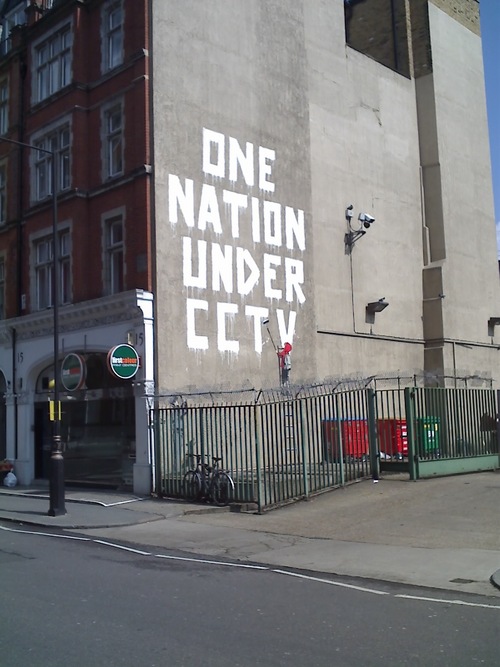
World famous British street artist Banksy has a message about the widespread CCTV in England and has chosen a large wall as the medium to express it. Via ONE NATION UNDER CCTV graffito in London - Boing Boing. See also Banksy pulls off daring CCTV protest in London - Telegraph.

Greater details in this Flickr set.

British Engineers' Report on Privacy and Surveillance

0 comments

The British Royal Academy of Engineers has published a very interesting report on privacy and technology: Dilemmas of Privacy and Surveillance. It is important that those that design technology have an appreciation of the privacy impact of that technology and this report is an encouraging step in that direction.

1. Executive Summary

This study identifies likely developments in information technology in the near future, considers their impact on the
citizen, and makes recommendations on how to optimize their benefits to society. The report focuses on an area where
the developments in IT have had a particularly significant impact in our everyday lives - the use of IT in surveillance,
data-capture, and identity management. It looks at the threats that these technologies may pose and at the role
engineering can play in avoiding and managing these risks. The following is a summary of the central concepts and
issues that the report investigates and the judgments the report makes about them.

Technological development: Technologies for the collection, storage, transmission and processing of data are
developing rapidly. These technological developments promise many benefits: improved means of storing and
analysing medical records and health data could lead to improvements in medical care and in management of public
health; electronic logging of journey details can promise improved provision of public transport and more logical
pricing for road use; and more details of peoples' everyday behaviour offer the possibility for developing better public
policy generally.

However, the development of these technologies also has the potential to impact significantly on privacy. How they
develop is to a large extent under the control of society. They can be allowed to develop in a way that means personal
data are open to the view of others - either centralised spies or local peeping toms. Or, they can be allowed to develop
so that personal data are collected and stored in an organised, controlled and secure manner. There is a choice
between a 'Big Brother' world where individual privacy is almost extinct and a world where the data are kept by
individual organisations or services, and kept secret and secure. The development of technology should be monitored
and managed so that its potential effects are understood and controlled. The possibility of failures of technologies
needs to be explored thoroughly, so that failures can be prepared for and, where possible, prevented.
Designing for privacy: There is a challenge to engineers to design products and services which can be enjoyed whilst
their users' privacy is protected. Just as security features have been incorporated into car design, privacy protecting
features should be incorporated into the design of products and services that rely on divulging personal information.

For example: means of charging road users for the journeys they make can be devised in such a way that an individuals'
journeys are kept private; ID or 'rights' cards can be designed so that they can be used to verify essential information
without giving away superfluous personal information or creating a detailed audit trail of individuals' behaviour;
sensitive personal information stored electronically could potentially be protected from theft or misuse by using digital
rights management technology. Engineering ingenuity should be exploited to explore new ways of protecting privacy.

Privacy and the law: British and European citizens have a right to privacy that is protected in law. The adequate
exercise of that right depends on what is understood by 'privacy'. This notion needs clarification, in order to aid the
application of the law, and to protect adequately those whose privacy is under threat. In particular, it is essential that
privacy laws keep up with the technological developments which impact on the right to and the expectation of privacy,
especially the development of the Internet as a networking space and a repository of personal information. The laws
protecting privacy need to be clarified in order to be more effective. As well as making the letter of the law more
perspicuous, the spirit must be made more powerful - the penalties for breaches of the Data Protection Act (1998) are
close to trivial. The report backs calls for greater penalties for misuse of data - including custodial sentences.

Surveillance: The level of surveillance of public spaces has increased rapidly over recent years, and continues to grow. Moreover, the development of digital surveillance technology means that the nature of surveillance has changed
dramatically. Digital surveillance means that there is no barrier to storing all footage indefinitely and ever-improving
means of image-searching, in tandem with developments in face and gait-recognition technologies, allows footage to
be searched for individual people. This will one day make it possible to 'Google spacetime', to find the location of a
specified individual at some particular time and date.

Methods of surveillance need to be explored which can offer the benefits of surveillance whilst being publicly
acceptable. This will involve frank discussion of the effectiveness of surveillance. There should also be investigation of
the possibility of designing surveillance systems that are successful in reducing crimes whilst reducing collateral
intrusion into the lives of law-abiding citizens.

Technology and trust: Trust in the government is essential to democracy. Government use of surveillance and data
collection technology, as well as the greater collection and storage of personal data by government, have the potential
to decrease the level of democratic trust significantly. The extent of citizens' trust in the government to procure and
manage new technologies successfully can be damaged if such projects fail. Essential to generating trust is action by
government to consider as wide a range of failure scenarios as possible, so that failures can be prevented where
possible, and government can be prepared for them where not. There also need to be new processes and agencies to
implement improvements. If a government is seen as implementing technologies wisely, then it will be considered
more trustworthy.

Protecting data: Loss or theft of personal data, or significant mistakes in personal data, can have catastrophic effects on
an individual. They may find themselves refused credit, refused services, the subject of suspicion, or liable for debts that
they did not incur. There is a need for new thinking on how personal data is stored and processed. Trusted third parties
could act as data banks, holding data securely, ensuring it is correct and passing it on only when authorised. Citizens
could have their rights over the ownership, use and protection of their personal data clarified in a digital charter which
would specify just how electronic personal data can be used and how it should be protected.

Equality: Personal data are frequently used to construct profiles and the results used to make judgements about
individuals in terms of their creditworthiness, their value to a company and the level of customer service they should
receive. Although profiling will reveal significant differences between individuals, the results of profiling should not be
used for unjustifiable discrimination against individuals or groups. Profiling should also be executed with care, to avoid
individuals being mistakenly classified in a certain group and thus losing rights which are legitimately theirs.

Reciprocity: Reciprocity between subject and controller is essential to ensure that data collection and surveillance
technologies are used in a fair way. Reciprocity is the establishment of two-way communication and genuine dialogue,
and is key to making surveillance acceptable to citizens. An essential problem with the surveillance of public spaces is
that the individual citizen is in no position either to accept or reject surveillance. This heightens the sense that we may
be developing a 'Big Brother' society. This should be redressed by allowing citizens access to more information about
exactly when, where and why they are being watched, so that they can raise objections to surveillance if it is deemed
unnecessary or excessively intrusive.

Recommendations

R1 Systems that involve the collection, checking and processing of personal information should be designed in order to
diminish the risk of failure as far as reasonably practicable. Development of such systems should make the best use of
engineering expertise in assessing and managing vulnerabilities and risks. Public sector organisations should take the
lead in this area, as they collect and process a great deal of sensitive personal data, often on a non-voluntary basis.

R2 Many failures can be foreseen. It is essential to have procedures in place to deal with the consequences of failure in
systems used to collect, store or process personal information. These should include processes for aiding and
compensating individuals who are affected.

R3 Human rights law already requires that everyone should have their reasonable expectation of privacy respected and
protected. Clarification of what counts as a reasonable expectation of privacy is necessary in order to protect this right
and a public debate, including the legal, technical and political communities, should be encouraged in order to work
towards a consensus on the definition of what is a 'reasonable expectation'. This debate should take into account the
effect of an easily searchable Internet when deciding what counts as a reasonable expectation of privacy.

R4 The powers of the Information Commissioner should be extended. Significant penalties - including custodial
sentences - should be imposed on individuals or organisations that misuse data. The Information Commissioner should
also have the power to perform audits and to direct that audits be performed by approved auditors in order to
encourage organisations to always process data in accordance with the Data Protection Act. A public debate should be
held on whether the primary control should be on the collection of data, or whether it is the processing and use of data
that should be controlled, with penalties for improper use.

R5 Organisations should not seek to identify the individuals with whom they have dealings if all they require is
authentication of rightful access to goods or services. Systems that allow automated access to a service such as public
transport should be developed to use only the minimal authenticating information necessary. When organisations do
desire identification, they should be required to justify why identification, rather than authentication, is needed. In such
circumstances, a minimum of identifying information should be expected.

R6 Research into the effectiveness of camera surveillance is necessary, to judge whether its potential intrusion into
people's privacy is outweighed by its benefits. Effort should be put into researching ways of monitoring public spaces
that minimise the impact on privacy - for example, pursuing engineering research into developing effective means of
automated surveillance which ignore law-abiding activities.

R7 Information technology services should be designed to maintain privacy. Research should be pursued into the
possibility of 'designing for privacy' and a concern for privacy should be encouraged amongst practising engineers and
engineering teachers. Possibilities include designing methods of payment for travel and other goods and services
without revealing identity and protecting electronic personal information by using similar methods to those used for
protecting copyrighted electronic material.

R8 There is need for clarity on the rights and expectations that individuals have over their personal information. A
digital charter outlining an individual's rights and expectations over how their data are managed, shared and protected
would deliver that clarity. Access by individuals to their personal data should also be made easier; for example, by
automatically providing free copies of credit reports annually.
There should be debate on how personal data are protected - how it can be ensured that the data are accurate, secure
and private. Companies, or other trusted, third-party organisations, could have the role of data banks - trusted
guardians of personal data. Research into innovative business models for such companies should be encouraged.

R9 Commercial organisations that select their customers or vary their offers to individuals on the basis of profiling
should be required, on request, to divulge to the data subjects that profiling has been used. Profiling will always be
used to differentiate between customers, but unfair or excessively discriminating profiling systems should not be
permitted.

R10 Data collection and use systems should be designed so that there is reciprocity between data subjects and owners
of the system. This includes transparency about the kinds of data collected and the uses intended for it; and data
subjects having the right to receive clear explanations and justifications for data requests. In the case of camera
surveillance, there should be debate on and research into ways to allow the public some level of access to the images
captured by surveillance cameras.

Thanks to DP thinker for the link.

George Orwell, Big Brother is watching your house

0 comments

This is London has a piece on CCTV in London and uses George Orwell's former house as a good illustration: Within 200 yards of the house are 28 CCTV cameras. See: George Orwell, Big Brother is watching your house - News - This is London,

What's new from Alberta

0 comments

There have been some interesting releases from the Information and Privacy Commissioner of Alberta's office:

OIPC

Order P2007-014

Posted: Mar/19/2008

Adjudicator rules personal information released in contravention of Personal Information Protection ActAn Adjudicator with the Office of the Information and Privacy Commissioner has ruled that the Alberta Teachers’ Association contravened the Personal Information Protection Act (PIPA), when it published an article containing the personal information of former members.

The Complainants filed the complaint when the ATA published their names in a newsletter stating that they no longer were required to adhere to the ATA’s Code of Professional Conduct.

The ATA argued while it had published personal information, it had done so for “journalistic purposes” and that PIPA did not apply.

The Adjudicator determined that PIPA did apply and that the information was disclosed contrary to sections 7 and 19 of PIPA.

Order F2007-026

Posted: Mar/18/2008

Adjudicator finds Alberta Energy and Utilities Board did not disclose personal information in contravention of the FOIP Act

Order F2007-019

Posted: Mar/11/2008

Information and Privacy Commissioner, Frank Work, has ruled that the parents of a student had no legal standing in a complaint over the seizure of their son’s cell phone. The Commissioner says he was not presented with any evidence under section 84 of the Freedom of Information and Protection of Privacy Act (FOIP) that the parents were authorized to act on behalf of their son, nor is there any evidence that the son is even aware of a complaint being made on his behalf.The parents complained to the Commissioner their son’s cell phone had been seized by school administrators who had accessed photographs contained on the phone.

During an inquiry into the matter, the Commissioner found the evidence did not establish that the parents had standing to make a complaint. The Commissioner also found there was little evidence that the son’s personal information had been collected or used by the school.

Investigation Report P2008-IR-002

Posted: Mar/06/2008

Commissioner releases investigation report on DeVry Institute of Technology, related to discovery of identity theft.

News Release P2008-IR-002

Posted: Mar/06/2008

Commissioner releases investigation report related to discovery of identity theft

News Release: New Video Surveillance Guidelines

Posted: Mar/06/2008

New guidelines set out how companies should evaluate the use of video surveillance that respects privacy rights and complies with the law.

Order F2008-007

Posted: Mar/06/2008

Adjudicator upholds decision not to release Crown Prosecutor records

Order P2008-001

Posted: Mar/06/2008

Adjudicator rules company tried to find applicant's personal information

Smile, Big Brother's watching

0 comments

I was interviewed some time ago for a Globe & Mail article on workplace surveillance, which appeared yesterday. The piece discusses keystroke loggers, access cards and video surveillance. See: globeandmail.com: Smile, Big Brother's watching.

Toilet cameras are for research purposes only

0 comments

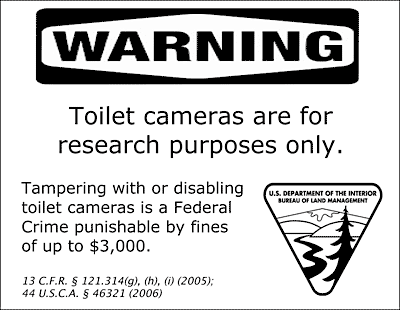
After the recent spate of toilet cam stories (Canadian Privacy Law Blog: Montreal mall fake toilet-cam raising concerns, Canadian Privacy Law Blog: Montreal Second Cup owner forced to take down bathroom surveillance camera), I was at first shocked, puzzled and then amused by the sticker that was posted on Boing Boing. It had been spotted in a bathroom in a San Francisco coffee shop. It turns out it was part of a prank created by Sean Savage at Cheesebikini, though commentators at Boing Boing say they were originally part of a set of stickers produced by Maxim Magazine. In the interests of science, I've discovered that there are others who put stickers up in bathrooms suggesting you are being watched, including a Flickr user who puts labels of "THIS IS A CAMERA" on bathroom fittings. For more info and a handy PDF to make your own labels, see: cheesebikini? » Blog Archive » Bathroom Prank.

Privacy Commissioners Release New Video Surveillance Guidelines

0 comments

The Privacy Commissioners of Canada, British Columbia and Alberta today have released Guidelines for Overt Video Surveillance in the Private Sector to help businesses consider privacy matters when deciding whether to and how to implement overt video surveillance. (I wonder whether they'll also produce guidelines on covert surveillance?)

From the media release:

Privacy Commissioners Release New Video Surveillance Guidelines

Privacy Commissioners Release New Video Surveillance Guidelines

OTTAWA, March 6, 2008 — Private-sector organizations considering video surveillance systems must take specific steps to minimize the impact on people’s privacy, say video surveillance guidelines released today.

The new guidelines set out how companies should evaluate the use of video surveillance and ensure any surveillance they undertake is conducted in a way that respects privacy rights and complies with the law.

These guidelines have been endorsed by Jennifer Stoddart, the Privacy Commissioner of Canada, Frank Work, the Information and Privacy Commissioner of Alberta, and David Loukidelis, the Information and Privacy Commissioner for British Columbia.

“We have seen a dramatic increase in the use of surveillance cameras by private-sector organizations. Many of our day-to-day activities are now captured by these cameras,” says Commissioner Stoddart.

“There are some legitimate reasons to conduct video surveillance, but privacy laws in Canada impose restrictions and obligations when, where and how businesses can conduct this kind of surveillance,” says Commissioner Loukidelis.

“These guidelines make it clear that businesses must carefully evaluate why they are installing video surveillance equipment, and what they will do with the information that is collected,” says Commissioner Work.

The Commissioners say it is disturbing to hear stories about video surveillance operators deliberately pointing cameras to ogle women, as well as surveillance images of people caught in unflattering situations finding their way onto video sharing sites like YouTube and Vimeo.

The new guidelines are aimed at businesses subject to the Personal Information Protection and Electronic Documents Act, or PIPEDA. They are also targeted at businesses subject to the provincial Personal Information Protection Acts in Alberta and British Columbia.

The overarching principle for video surveillance – which stems from the key legal test under the federal and provincial laws – is that it should be used only for purposes that a reasonable person would consider appropriate in the circumstances.

The guidelines state that, in order to limit the impact on privacy, cameras should be positioned to avoid capturing the images of people not being targeted (e.g., someone walking outside a store). As well, cameras should not be used in areas where people have a heightened expectation of privacy, such as washrooms, and through building windows.

The guidelines also say:

  • People should be notified about the use of cameras before they enter the premises.
  • Individuals whose images are captured on videotape should, upon request, be given access to this recorded personal information.
  • Organizations must ensure that video surveillance equipment and videotapes are secured and used for authorized purposes only.
  • Individuals who operate video surveillance systems should understand the privacy issues related to surveillance and their obligations under the law.
  • Video surveillance recordings should be retained only as long as necessary and destroyed securely.

The complete guidelines for private-sector organizations are available at www.privcom.gc.ca, www.oipc.ab.ca and www.oipc.bc.ca. The Office of the Privacy Commissioner of Canada and the Office of the Information and Privacy Commissioner for British Columbia have previously published guidelines for the use of video surveillance in public places by police and law enforcement authorities.

All three privacy commissioners are statutorily mandated to oversee compliance with the Acts and are advocates and guardians of privacy and the protection of personal information rights of Canadians.

Ontario Commissioner releases detailed report on TTC surveillance cameras

0 comments

The Information and Privacy Commissioner of Ontario has released an extensive report on the use of video surveillance by the Toronto Transit Commission. The report can be found here: Privacy and Video Surveillance in Mass Transit Systems: A Special Investigation Report - Privacy Investigation Report MC07-68.

From the media release:


TTC’s surveillance cameras comply with privacy Act,
but additional steps needed to enhance privacy protection,
says Privacy Commissioner Ann Cavoukian

TORONTO – Ontario Information and Privacy Commissioner Ann Cavoukian ruled today that the Toronto Transit System’s expansion of its video surveillance system, for the purposes of public safety and security, is in compliance with Ontario’s Municipal Freedom of Information and Protection of Privacy Act – but she is calling on the TTC to undertake a number of specific steps to enhance privacy protection.

The Commissioner’s office conducted a four-month special investigation that went beyond the scope of the usual privacy investigation conducted in that it included:

  • A detailed review of the literature and analysis from various parts of the world on the effectiveness of video surveillance;
  • An examination of the role that privacy-enhancing technologies can play in mitigating the privacy-invasive nature of video surveillance cameras; and
  • A detailed investigation into a privacy complaint by U.K-based Privacy International about the expansion of the TTC’s video surveillance system.

“Video surveillance presents a difficult subject matter for privacy officials to grapple with impartially because, on its face, it is inherently privacy-invasive due to the potential for data capture – despite that fact, there are legitimate uses for video surveillance … that render it in compliance with our privacy laws,” said the Commissioner. “Mass transit systems like the TTC, that are required to move large volumes of people, in confined spaces, on a daily basis, give rise to unique safety and security issues for the general public and operators of the system.”

“The challenge we thus face is to rein in, as tightly as possible, any potential for the unauthorized deployment of the system. We have attempted to do this by ensuring that strong controls are in place with respect to its governance (policy/procedures), oversight (independent audit, reportable to my office) and, the most promising long-term measure, the introduction of innovative privacy-enhancing technologies to effectively eliminate unauthorized access or use of any personal information obtained.”

While the expectation of privacy in public places is not the same as in private places, it does not disappear. People have the right, the Commissioner stresses in her report, to expect the following when it comes to video surveillance:

  • That their personal information will only be collected for legitimate, limited and specific purposes;
  • That the collection will be limited to the minimum necessary for the specified purposes; and
  • That their personal information will only be used and disclosed for the specified purposes.

“These general principles,” said Commissioner Cavoukian, “should apply to all video surveillance systems. Where developments such as video surveillance in mass transit systems, like the TTC, can be shown to be needed for public safety, you must also ensure that threats to privacy are kept to an absolute minimum.”

Among the 13 recommendations the Commissioner is making to the TTC are the following:


  • That the TTC reduce its retention period for video surveillance images from a maximum of seven days to a maximum of 72 hours (the same standard as the Toronto Police), unless required for an investigation;

  • That the TTC’s video surveillance policy should specifically state that the annual audit must be thorough, comprehensive, and must test all program areas of the TTC employing video surveillance to ensure compliance with the policy and the written procedures. The initial audit should be conducted by an independent third party using Generally Accepted Privacy Principles, and should include an assessment of the extent to which the TTC has complied with the recommendations made in this special report;

  • That the TTC should select a location to evaluate the privacy-enhancing video surveillance technology developed by University of Toronto researchers, K. Martin and K. Plataniotis; and

  • That, prior to providing the police with direct remote access to the video surveillance images, the TTC should amend the draft memorandum of understanding (MOU) with the Toronto Police to require that the logs of disclosures be subjected to regular audits, conducted on behalf of the TTC. A copy of the revised draft MOU should be provided to the Commissioner prior to signing.

EMERGING PRIVACY-ENHANCING TECHNOLOGY

The Commissioner devotes part of her 50-page special report, and a specific recommendation, to the area of emerging privacy-enhancing video surveillance technology.

“In light of the growth of surveillance technologies, not to mention the proliferation of biometrics and sensoring devices, the future of privacy may well lie in ensuring that the necessary protections are built right into their design,” said the Commissioner. “Privacy by
design may be our ultimate protection in the future, promising a positive sum paradigm instead of the unlikely obliteration of a given technology.”

As an example of the research being conducted into privacy-enhancing technologies, the Commissioner cites the work of researchers Karl Martin and Kostas Plataniotis at the University of Toronto, who used cryptographic techniques to develop a secure object-based coding approach. While the background image captured by a surveillance camera can be viewed, the sections where individuals are caught in the image would automatically be encrypted by the software. Designated staff could monitor the footage for unauthorized activity, but would not be able to identify anyone. Only a limited number of designated officials with the correct encryption key could view the full image.

The Commissioner is recommending that the TTC select a location to evaluate the video surveillance technology developed by Martin and Plataniotis.

A copy of the special report is available on the IPC’s website, www.ipc.on.ca.

Cool Followers

Popular entries

Save Law online publisher on social network: